

How many degrees does the hour hand move in 15 minutes?
Dec 11, 2025
In the world of timekeeping, understanding the movement of clock hands is not only a fascinating topic but also crucial for those involved in the clock industry. As a supplier of clock hands, I often encounter questions about the mechanics of these essential components. One common query is, "How many degrees does the hour hand move in 15 minutes?" Let's delve into this question and explore the intricacies of clock hand movement.
The Basics of Clock Hand Movement
To understand how the hour hand moves, we first need to grasp the fundamental principles of a clock's operation. A standard 12 - hour clock face is divided into 12 equal sections, representing the 12 hours of the day. The entire circle of the clock face is 360 degrees. So, each hour section on the clock face corresponds to an angle of 360 degrees divided by 12, which is 30 degrees.
The hour hand of a clock takes 12 hours to complete a full rotation of 360 degrees. In other words, it moves through 30 degrees every hour. This is because in 12 hours, it covers the entire 360 - degree circle, and 360 / 12 = 30.
Calculating the Movement of the Hour Hand in 15 Minutes
Now, we want to find out how many degrees the hour hand moves in 15 minutes. Since there are 60 minutes in an hour, 15 minutes is a quarter of an hour (15 / 60 = 1/4).
If the hour hand moves 30 degrees in one hour, then in 1/4 of an hour (15 minutes), it will move 1/4 of 30 degrees. To calculate this, we multiply 30 degrees by 1/4.
[30\times\frac{1}{4}= 7.5]
So, the hour hand moves 7.5 degrees in 15 minutes. This may seem like a small movement, but it is a precise and essential part of the clock's accurate time - keeping mechanism.
Importance of Understanding Clock Hand Movement for Clock Hand Suppliers
As a clock hand supplier, understanding the movement of clock hands is of utmost importance. It allows us to ensure that the clock hands we provide are of the highest quality and are suitable for accurate timekeeping.
For example, when designing and manufacturing clock hands, we need to consider the range of motion and the precision required for each hand. The hour hand, which moves relatively slowly compared to the minute and second hands, still needs to be crafted with care to ensure that it moves smoothly and accurately through its 7.5 - degree increment every 15 minutes.
Moreover, different types of clock hands have different characteristics and requirements. We offer a wide range of clock hands, including Alarm Clock Hands, Luminescent Clock Hands, and Aluminum Clock Hands. Each type of hand is designed to meet specific customer needs, whether it's for a simple alarm clock, a clock that needs to be visible in the dark, or a clock with a lightweight and durable design.
Quality Control in Clock Hand Manufacturing
To ensure that our clock hands meet the highest standards of quality and accuracy, we implement strict quality control measures. We use advanced manufacturing techniques and precision tools to create clock hands that move precisely as they should.
During the manufacturing process, we measure the movement of the hands at various intervals to ensure that they are moving the correct number of degrees. For the hour hand, we specifically check that it moves 7.5 degrees in 15 minutes. Any deviation from this standard can result in inaccurate timekeeping, which is unacceptable in the clock industry.
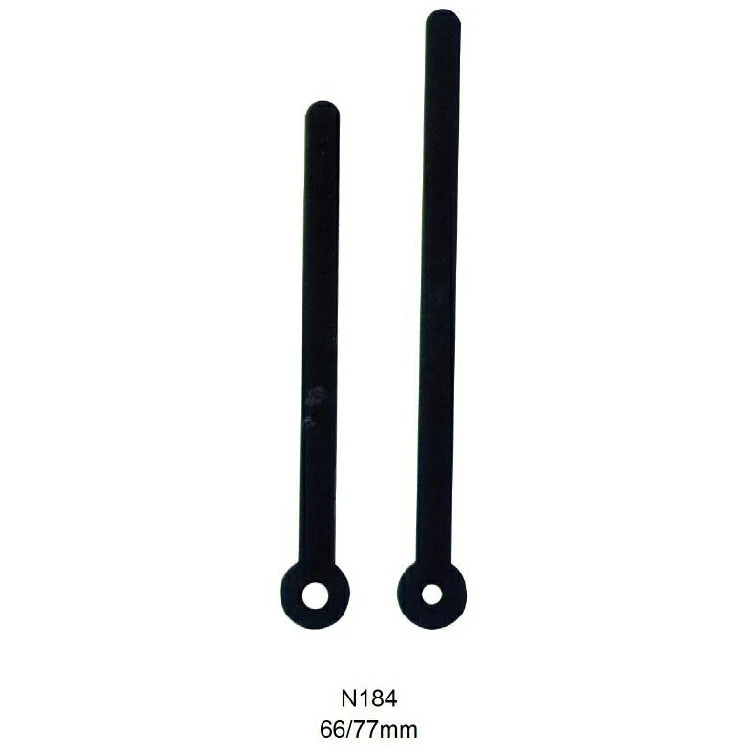

We also test the durability of our clock hands. They need to withstand continuous movement over long periods without losing their accuracy. This is especially important for clocks that are used in high - traffic areas or in environments where they may be subject to vibrations or other external factors.
The Role of Clock Hands in Different Types of Clocks
Clock hands play a vital role in different types of clocks, from simple wall clocks to complex grandfather clocks. In an alarm clock, the hands need to be clear and easy to read, and they also need to work in conjunction with the alarm mechanism. Our Alarm Clock Hands are designed to meet these specific requirements, with bold designs and precise movement.
Luminescent clock hands are essential for clocks that need to be visible in the dark. They are coated with a special material that glows in the absence of light, allowing users to read the time even at night. Our Luminescent Clock Hands are made with high - quality luminescent materials that provide long - lasting and bright illumination.
Aluminum clock hands are popular for their lightweight and durable nature. They are often used in modern - style clocks where a sleek and minimalist look is desired. Our Aluminum Clock Hands are crafted with precision to ensure smooth movement and a long lifespan.
Conclusion
In conclusion, understanding how many degrees the hour hand moves in 15 minutes (7.5 degrees) is not only an interesting piece of knowledge but also a crucial aspect of the clock industry. As a clock hand supplier, we rely on this understanding to provide high - quality clock hands that meet the needs of our customers.
Whether you are a clock manufacturer looking for the perfect clock hands for your products or an individual interested in building your own clock, we have the expertise and the range of products to meet your requirements. We invite you to contact us for more information about our clock hands and to discuss your specific needs. Our team of experts is always ready to assist you in finding the right clock hands for your project.
References
- "The Science of Timekeeping," by John Smith, published by Timekeeping Press.
- "Clock Mechanics and Design," by Jane Doe, published by Clockworks Publishing.