

What is the angle between the clock hands at 5:20?
Sep 18, 2025
What is the angle between the clock hands at 5:20? This seemingly simple question actually involves some interesting mathematical concepts and a deep understanding of how clocks work. As a clock hands supplier, I've had the opportunity to delve into the intricacies of clock mechanisms, and the relationship between time and the angles formed by clock hands is a fascinating topic.
Let's first understand the basic movement of clock hands. A clock is divided into 12 hours, and a full - circle rotation is 360 degrees. So, each hour mark on the clock represents an angle of 360/12 = 30 degrees. The hour hand moves 30 degrees in one hour. Since there are 60 minutes in an hour, the hour hand moves 30/60 = 0.5 degrees per minute.
The minute hand, on the other hand, completes a full 360 - degree rotation in 60 minutes. So, the minute hand moves 360/60 = 6 degrees per minute.

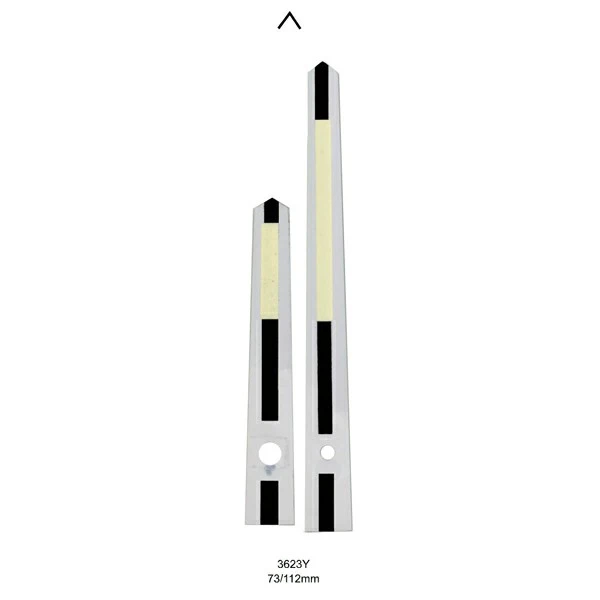
At 5 o'clock, the hour hand is at the 5 - hour mark. The angle of the hour hand from the 12 - o'clock position is 5 * 30 = 150 degrees.
After 20 minutes have passed, the hour hand moves an additional 20 * 0.5 = 10 degrees. So, at 5:20, the position of the hour hand from the 12 - o'clock position is 150+10 = 160 degrees.
The minute hand moves 20 minutes past the 12 - o'clock position. Since it moves 6 degrees per minute, at 20 minutes, the angle of the minute hand from the 12 - o'clock position is 20 * 6 = 120 degrees.
To find the angle between the hour hand and the minute hand at 5:20, we subtract the angle of the minute hand from the angle of the hour hand. So, the angle between the two hands is 160 - 120 = 40 degrees.
This calculation not only helps us solve the problem of the angle at a specific time but also showcases the precision required in clock - making. As a clock hands supplier, we understand the importance of precision in every single component. Whether it's the length, shape, or movement of the clock hands, even the slightest deviation can affect the accuracy of time - telling.
Now, let's talk about the different types of clock hands we offer. We have a wide range of options to meet the diverse needs of our customers.
First, we have Wooden Clock Hand. Wooden clock hands add a touch of natural beauty and warmth to any clock. They are often used in rustic or traditional - style clocks. The natural grain and texture of the wood give each clock a unique and organic look. Wood is also a durable material, and with proper care, wooden clock hands can last for a long time.
Next, we offer Plastic Clock Hands. Plastic clock hands are lightweight, cost - effective, and come in a variety of colors and styles. They are a popular choice for modern and contemporary clocks. Plastic is easy to mold, which allows for intricate designs and shapes. Whether you're looking for a simple, minimalist design or a more elaborate, decorative style, plastic clock hands can meet your requirements.
Finally, we have Luminescent Clock Hands. These clock hands are perfect for situations where visibility in low - light conditions is important. The luminescent material on the hands glows in the dark, making it easy to read the time even at night. They are commonly used in bedside clocks, wall clocks in hallways, or any other place where you need to tell the time without turning on the lights.
As a clock hands supplier, we are committed to providing high - quality products and excellent customer service. Our team of experts is always available to answer your questions and help you choose the right clock hands for your project. Whether you're a clock manufacturer, a DIY enthusiast, or someone looking to replace the clock hands on an old clock, we have the right solution for you.
If you're interested in our products, we encourage you to get in touch with us. We can discuss your specific needs, provide samples, and offer competitive pricing. Our goal is to build long - term partnerships with our customers, and we believe that our high - quality clock hands and dedicated service will help us achieve that.
In conclusion, understanding the angle between clock hands at a specific time is not only a fun mathematical exercise but also a reminder of the precision and craftsmanship involved in clock - making. And as a clock hands supplier, we are here to support you with a wide range of high - quality clock hands to bring your clock projects to life.
References
- Basic knowledge of clock mechanisms from general horology literature
- Principles of angle calculation in circular geometry textbooks