

What is the angle between the clock hands at 7:50?
Dec 03, 2025
As a seasoned clock hands supplier, I often find myself delving into the intricate world of timekeeping. One question that frequently piques the curiosity of clock enthusiasts and customers alike is, "What is the angle between the clock hands at 7:50?" This seemingly simple query opens the door to a fascinating exploration of geometry, mechanics, and the art of clockmaking.
To understand the angle between the clock hands at 7:50, we first need to grasp the basic principles of how a clock works. A standard 12 - hour clock is divided into 12 equal sections, each representing an hour. The full circle of a clock is 360 degrees, so each hour section corresponds to an angle of 360/12 = 30 degrees.
Let's start by analyzing the position of the hour hand. At 7 o'clock, the hour hand is precisely at the 7 - hour mark, which is 7 * 30 = 210 degrees from the 12 - o'clock position. However, as time progresses, the hour hand doesn't stay fixed at the 7 - hour mark. In fact, it moves continuously. In 60 minutes, the hour hand moves through 30 degrees (the angle of one hour section). So, in 1 minute, the hour hand moves 30/60 = 0.5 degrees.
At 7:50, 50 minutes have passed since 7 o'clock. Therefore, the additional movement of the hour hand from the 7 - hour mark is 50 * 0.5 = 25 degrees. So, the total angle of the hour hand from the 12 - o'clock position at 7:50 is 210+25 = 235 degrees.
Now, let's look at the position of the minute hand. The minute hand moves through a full 360 - degree circle in 60 minutes. So, in 1 minute, the minute hand moves 360/60 = 6 degrees. At 7:50, since 50 minutes have passed, the minute hand is at an angle of 50 * 6 = 300 degrees from the 12 - o'clock position.
To find the angle between the hour hand and the minute hand at 7:50, we subtract the angle of the hour hand from the angle of the minute hand. So, the angle between the two hands is 300 - 235 = 65 degrees.
This calculation not only showcases the mathematical precision required in timekeeping but also highlights the importance of accurate clock hands. As a clock hands supplier, I understand the significance of producing hands that can move smoothly and precisely to ensure accurate time display.
We offer a wide range of clock hands to meet the diverse needs of our customers. For those looking for a touch of uniqueness, our Luminescent Clock Hands are an excellent choice. These hands glow in the dark, making the clock visible even in low - light conditions. They are perfect for bedside clocks or clocks in dimly lit rooms.
Our Clock Hands Sets provide a convenient solution for clockmakers. Each set includes all the necessary hands - hour, minute, and sometimes second hands - in a coordinated design. This ensures that the clock has a cohesive and professional look.
If you prefer a more natural and rustic aesthetic, our Wooden Clock Hand is the ideal option. Crafted from high - quality wood, these hands add a warm and organic touch to any clock.

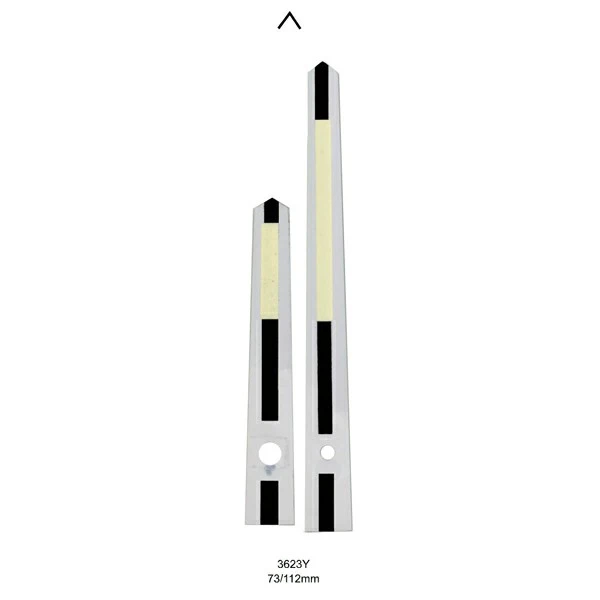
Whether you are a professional clockmaker, a hobbyist, or someone looking to repair or customize a clock, our clock hands are designed to meet your requirements. We take pride in our commitment to quality and precision. Each clock hand is carefully crafted and tested to ensure smooth movement and accurate timekeeping.
Our team of experts is always ready to assist you in choosing the right clock hands for your project. We understand that every clock is unique, and we strive to provide personalized solutions. If you have any questions about our products, installation, or the angle between clock hands, don't hesitate to reach out to us.
In conclusion, the angle between the clock hands at 7:50 is 65 degrees. This simple yet elegant calculation is a testament to the beauty and complexity of timekeeping. And as a clock hands supplier, we are dedicated to providing the highest - quality products to ensure that your clocks keep time with precision and style.
If you are interested in our clock hands or have any inquiries, please feel free to contact us. We look forward to discussing your needs and working with you to create or enhance your timepieces.
References
- Basic principles of clock mechanics from general horology knowledge.
- Geometric calculations based on standard circle angle concepts.